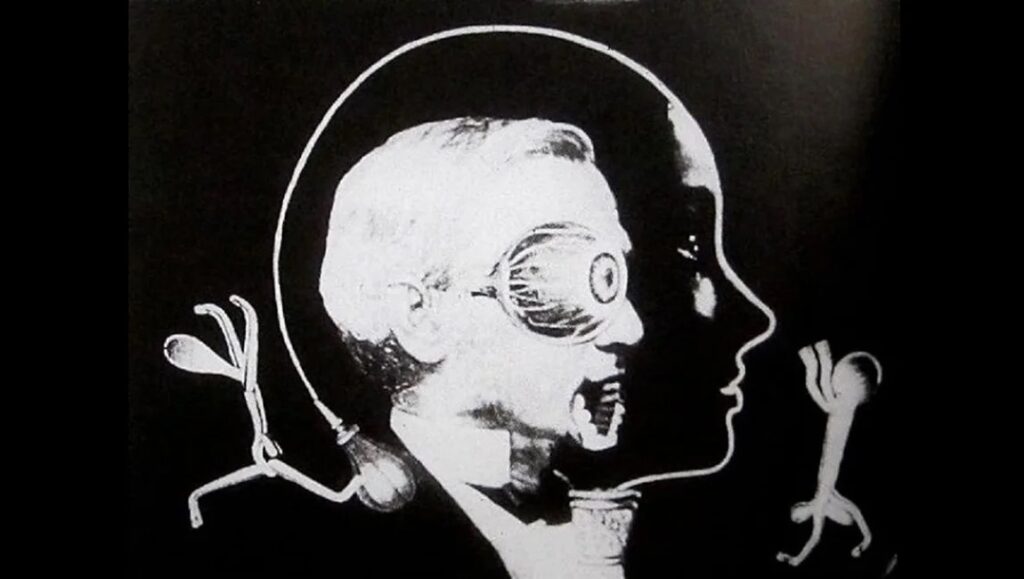
Heaven and Earth Magic (1957-1962) by Harry Smith
Friday, September 4, 2026, 9:30 pm
CROSSROADS 2026 – program 2
JG Thirlwell scores Harry Smith’s Heaven and Earth Magic
CROSSROADS opening night culminates in a rare screening of psychedelic archivist, ethnomusicologist, filmmaker, mystic and paper airplane hoarder Harry Smith’s legendary work of obsessive cinematic stop-motion occultism, the primitively hypnotic and hallucinatory Heaven and Earth Magic (1957-1962) presented with a live score by the equally legendary industrial noise composer JG Thirlwell, performing a surround sound soundtrack using electronics, triggered samples and theremin. Program opens with Thirlwell’s 2018 film Sonder. Join us for an appropriately incantatory inauguration of the weekend’s haunted festivities.
SCREENING:
Sonder (2018) by J.G. Thirlwell; digital video, color, 11 minutes. Heaven and Earth Magic (1957-1962) by Harry Smith; 16mm screened as digital video, b&w, 66 minutes. DCP from Anthology Film Archives.
TRT: 77 minutes
Harry Smith’s most famous work came in 1960, the mysterious spiritual cut out epic Film #12 (or, as named by fellow abstract film-maker and friend Jonas Mekas, Heaven and Earth Magic). The film seems to have been made between 1950 and 1960. During this process Smith often used sleep deprivation as a gateway to spirituality and the subconscious, a process of falling asleep, awaking and resuming work continuously next to his camera. In Smith’s words this was “to make the whole thing automatic… some kind of universal process was directing these so-called arbitrary processes.” Smith gave a typically mysterious summary of the narrative as follows: “The first part depicts the heroine’s toothache consequent to the loss of a very valuable watermelon, her dentistry and transportation to heaven. Next follows an elaborate exposition of the heavenly land, in terms of Israel and Montreal. The second part depicts the return to Earth from being eaten by Max Müller on the day Edward VII dedicated the Great Sewer of London.” (Stephen Cavalier)
PROGRAM TICKETS: $20 General/$15 Cinematheque Members, Gray Area Members & students (with ID)
FESTIVAL PASSES: $85 General/$70 Cinematheque Members, Gray Area Members & students (with ID)
← 1 2 3 4 5 6 7 8 →
CROSSROADS 2026
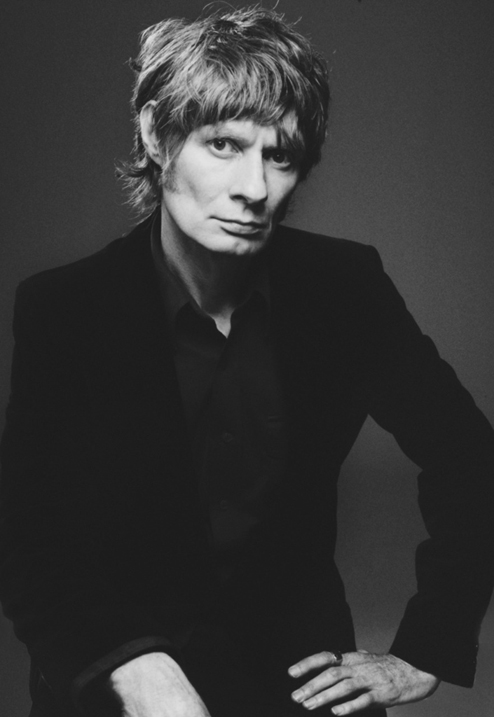 JG Thirlwell is a composer/producer/performer based in Brooklyn. Born in Melbourne, he moved to London in 1978, then relocated to NYC in 1983, where he has been based ever since. As well as his own name, he works under many pseudonyms including Manorexia, Foetus, Xordox, Steroid Maximus, Baby Zizanie, Hydroze Plus, Clint Ruin and Wiseblood. Thirlwell has released over thirty albums. If there is a common thread to his varied musical styles, it is a dramatic intensity and an evocative, cinematic quality. Thirlwell has also featured as producer, remixer, collaborator or arranger for a wide variety of artists including Karen O, Noveller, Excepter, Zola Jesus, Melvins, Swans, Nine Inch Nails, Lydia Lunch, Coil, Z’s, The The, Simon Hanes, Nick Cave and many more. Thirlwell has completed commissions for Kronos Quartet, Bang On A Can, String Orchestra of Brooklyn, Experiments in Opera, Zephyr Quartet, Great Learning Orchestra, Jeffrey Zeigler, League of Electronic Musical Urban Robots and more and is a member of the“freq_out” sound-art collective, curated by CM Von Hausswolff, who create on-site sound and light installations. In 2010, he received a fellowship from New York Foundation of the Arts in sound / composition. Thirlwell has created solo sound installations which have exhibited in Santarcangelo, Italy and Kaliningrad, Russia. He performs live with a chamber ensemble version of his Manorexia project, as JG Thirlwell with his electro-acoustic “Cholera Nocebo” project and with his electronic project Xordox. Kaliningrad also creates the musical score for the Emmy-winning FX show Archer, and for Adult Swim/Cartoon Network show The Venture Bros, for which he was nominated for an Annie Award. Thirlwell has also created several motion picture scores as well as Tony Oursler’s film installation Imponderable which was on exhibit at the Museum of Modern Art in New York in 2017.
 Existing as a semi-mythological creature even while alive, Harry Smith regularly fabricated or embellished aspects of his origins and accomplishments, slipping in and out of peoples’ grasp with an intensity that could swing along a spectrum from kind and charismatic to belligerent. Throughout his time on this planet, he cultivated different audiences as a filmmaker, multimedia artist of every dimension, anthropologist, music anthologist, aural documentarian, quixotic mechanical engineer and expert on innumerable esoteric subjects. Aided by a deep interest in alchemy, magic, drug-induced states and Native American culture, along with his apparent asexuality and quantum view of an interconnected cosmos, he also seemed a prescient mystic. Recognizing patterns in everything, he was never a casual listener of music—including classical, folk, jazz, country, blues and all kinds of indigenous music—but experienced it as a complex, multidimensional communication that some of his films and paintings would attempt to analyze. He was also a famous collector, not only of rare records, but of objects such as Ukrainian Easter eggs, paper airplanes and string figures. His archivist and late-in-life friend Rani Singh adds that “Smith compulsively collected everything from books, pop-up books, audio recordings, Indian women’s beaded costumes, tarot cards, and gourds to things shaped like other things (spoons shaped like ducks, banks shaped like apples, anything shaped like a hamburger).” The myth of Harry Smith is further heightened by its gaps; a semi-transient lifestyle mixed with an unpredictable, frequently substance-addled and fiery nature led to his either losing or destroying many of his collections, art and writing. Fortunately, many of his films managed to endure. (Brittany Gravely, Harvard Film Archive) Portrait by Allen Ginsberg.